Materials for a San Gabriel Mission Project People Making a Baby
 A view of Mission San Gabriel Arcángel in April 2005. The open stairway at the far correct leads to the choir loft, and to the left is the six-bell campanario ("bell wall") that was built later the original bell construction, located at the far cease of the church, toppled during the 1812 San Juan Capistrano earthquake. | |
| Location in Los Angeles County | |
| Location | 428 Southward Mission Dr. San Gabriel, California 91776-1299 |
|---|---|
| Coordinates | 34°05′48″North 118°06′24″W / 34.09667°N 118.10667°W / 34.09667; -118.10667 Coordinates: 34°05′48″N 118°06′24″W / 34.09667°N 118.10667°West / 34.09667; -118.10667 |
| Name as founded | La Misión del Santo Príncipe el Arcángel, San Gabriel de los Temblores[one] |
| English translation | The Mission of the Saintly Prince The Archangel, St. Gabriel of the Tremblors |
| Patron | Gabriel, Holy Prince of Archangels[2] |
| Nickname(due south) | "Pride of the Alta California Missions"[ commendation needed ] "Female parent of Agronomics in California"[iii] |
| Founding date | September 8, 1771[four] |
| Founding priest(s) | Pedro Benito Cambón and Ángel de la Somera (1st); Begetter Presidente Junípero Serra (2d)[5] |
| Founding Club | Fourth[ii] |
| Military district | First[6] [seven] |
| Native tribe(s) Castilian proper noun(southward) | Tongva Gabrieleño |
| Native place proper name(southward) | 'Iisanchanga, Shevaanga[eight] |
| Baptisms | 7,825[ix] |
| Marriages | 1,916[9] |
| Burials | 5,670[nine] |
| Secularized | 1834[two] |
| Returned to the Church | 1859[ii] |
| Governing body | Roman Catholic Archdiocese of Los Angeles |
| Current utilize | Chapel / Museum |
| U.Due south. National Register of Celebrated Places | |
| Designated | 1971 |
| Reference no. | #71000158 |
| California Historical Landmark | |
| Reference no. | #158 |
| Website | |
| http://www.sangabrielmission.org | |


Mission San Gabriel Arcángel (Spanish: Misión de San Gabriel Arcángel) is a Californian mission and historic landmark in San Gabriel, California. It was founded by Spaniards of the Franciscan gild on "The Feast of the Nascence of Mary," September 8, 1771, every bit the quaternary of what would become 20-one Spanish missions in California.[10] San Gabriel Arcángel was named after the Archangel Gabriel and frequently referred to as the "Godmother of the Pueblo of Los Angeles."[11] The mission was built and run using what has been described as slave labor[12] from nearby Tongva villages, such as Yaanga. When the nearby Pueblo de los Ángeles was built in 1781, the mission competed with the emerging pueblo for control of Indigenous labor.[13]
The mission was designed by Antonio Cruzado, who gave the building its capped buttresses and the tall narrow windows, which are unique amid the missions of the California concatenation. A large stone cantankerous stands in the center of the Campo Santo (cemetery), showtime consecrated in 1778 and then again on January 29, 1939, past the Los Angeles Archbishop John Cantwell. Information technology serves equally the final resting place for some six,000 "neophytes;" a small stone marker denotes the gravesite of José de los Santos, the last American Indian to be buried on the grounds, at the age of 101 in February 1921.
Too interred at the Mission are the bodies of numerous Franciscan priests who died during their time of service, as well as the remains of Reverend Raymond Catalan, C.M.F., who undertook the restoration of the Mission's gardens. Entombed at the human foot of the altar are the remains of eight Franciscan priests (listed in gild of interment): Miguel Sánchez, Antonio Cruzado, Francisco Dumetz, Ramón Ulibarri, Joaquín P. Núñez, Gerónimo Boscana, José Bernardo Sánchez, and Blas Ordaz. Cached among the priests is centenarian Eulalia Pérez de Guillén Mariné, the "keeper of the keys" under Spanish rule; her grave is marked by a demote dedicated in her memory.
According to Spanish legend, the founding expedition was confronted by a big group of native Tongva peoples whose intention was to drive the strangers away. One of the priests laid a painting of "Our Lady of Sorrows" on the footing for all to see, whereupon the natives, designated by the settlers as the Gabrieleños, immediately made peace with the missionaries, because they were so moved by the painting's beauty.[1] Today the 300-year-onetime work hangs in front of and slightly to the left of the old high altar and reredos in the Mission's sanctuary. Resistance to the mission by the Tongva was recorded[14] and how much the neophytes embraced Catholicism remains a subject of debate amid scholars.[15]
History [edit]
In August 1771, the Portolà expedition, which consisted of "ten Spanish soldiers and 2 Franciscan priests, encountered armed Tongva Indians on the banks of the Santa Ana River."[16] One month later, Mission San Gabriel was founded on September 8, 1771, by Fray Ángel Fernández de la Somera and Fray Pedro Benito Cambón. The planned site for the Mission was along the banks of the Río de los Temblores (the River of the Earthquakes—the Santa Ana River). The priests chose an alternate site on a fertile plain located straight aslope the Río Hondo in the Whittier Narrows.[17] The site of the Misión Vieja (or "Sometime Mission") is located near the intersection of San Gabriel Boulevard and Lincoln Avenue.
The expedition of Juan Bautista de Anza visited the mission in January and February 1776, having previous been there in 1774.[18] In 1776, a wink flood destroyed much of the crops and ruined the original Mission complex, which was later relocated v miles closer to the mountains in nowadays-day San Gabriel (the Tongva settlement of 'Iisanchanga). The Tongva hamlet of Shevaanga was located "close to the second location of Mission San Gabriel" after the original site was abandoned due to the flooding.[19]
On December 9, 1812 (the "Feast Day of the Immaculate Conception of the Blessed Virgin"), a series of massive earthquakes shook Southern California. The 1812 San Juan Capistrano convulsion acquired the three-bell campanario, located adjacent to the chapel'due south e façade, to collapse. A larger, six-bell structure was subsequently constructed at the far terminate of the Capilla. While no pictorial record exists to document what the original construction looked like, architectural historian Rexford Newcomb deduced the pattern and published a depiction in his 1916 work The Franciscan Mission Architecture of Alta (upper) California.
Over 25,000 baptisms were conducted at San Gabriel between 1771 and 1834, making it the most prolific in the chain of missions. Tongva people from nearby settlements like Akuranga village were affected by the practices of Franciscan missionaries, who attempted to "eradicate what they perceived as ills within Tongva society" through "religious indoctrination, labor, restructuring of gender structures, and violence," which took place at and around the Mission.[16] A missionary during this menses reported that three out of 4 children died at Mission San Gabriel earlier reaching the age of 2.[20] Near half dozen,000 Tongva lie buried in the grounds of the San Gabriel Mission.[21]
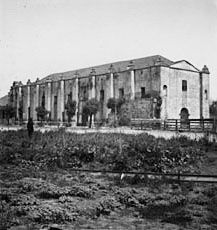
Mission San Gabriel Arcángel c. 1900. The trail in the foreground is part of the original El Camino Real.
Although San Gabriel once furnished food and supplies to settlements and other missions throughout California, a majority of the Mission structures brutal into ruins afterwards it was secularized in Nov 1834. The once-extensive vineyards were falling to decay, with fences broken down and animals roaming freely through it.[22]
The Mission's chapel functioned as a parish church for the City of San Gabriel from 1862 until 1908, when the Claretian Missionaries came to San Gabriel and began the task of rebuilding and restoring the Mission. In 1874, tracks were laid for Southern Pacific Railroad near the mission. In 2012, artifacts from the mission era were found when the tracks were lowered into a trench known as the Alameda Corridor-East.[23] On October 1, 1987, the Whittier Narrows earthquake damaged the holding. A meaning portion of the original complex has since been restored.
Fire completely destroyed the roof of the original church sanctuary on July 11, 2020.[24] Prior to the burn, the mission was undergoing renovation, saving some paintings and artifacts.[25] An investigation into the origin of the fire was opened.[26] On May 5, 2021 John David Corey, historic period 57, was charged with felony counts of arson and burglary for setting the fire.[27]
Mission industries [edit]
The goal of the missions was to become cocky-sufficient in relatively curt order. Farming was the well-nigh important industry of whatsoever mission. Prior to the missions, the Native Americans had developed a circuitous, self-sufficient civilization. The mission priests established what they thought of as a manual grooming school: to teach the Indians their fashion of agriculture, the mechanical arts, and the raising and care of livestock. The missions, utilizing the labor of the neophytes, produced everything they used and consumed. After 1811, the mission Indians could be said to sustain the unabridged armed services and civil government of California.[28]
Ranchos (not to be confused with secular government state-grant ranchos) were established in a wide expanse for raising cattle, sheep and other livestock. These included; San Pasqual, Santa Anita, Azusa, San Francisquito, Cucumonga, San Antonio, San Bernardino, San Gorgonio, Yucaipa, Jurupa, Guapa, Rincon, Chino, San Jose, Ybarras, Puente, Mission Vieja, Serranos, Rosa de Castilla, Coyotes, Jabonaria, Las Bolsas, Alamitos, and Cerritos.[29] When Rancho San Gorgonio was established in 1824, in what today is known as the San Gorgonio Pass, it became the nigh distant rancho operated by the San Gabriel Mission.[30]
Many of the Native Americans lived in communities called rancherías. "The names of the rancherías associated with San Gabriel Mission were: Acuragna, Alyeupkigna, Awigna, Azucsagna, Cahuenga, Chokishgna, Chowigna, Cucomogna, Hahamogna, Harasgna, Houtgna, Hutucgna, Isanthcogna, Maugna, Nacaugna, Pascegna, Pasinogna, Pimocagna, Pubugna, Sibagna, Sisitcanogna, Sonagna, Suangna, Tibahagna, Toviscanga, Toybipet, Yangna."[31]
To efficiently manage its all-encompassing lands, Mission San Gabriel established several outlying sub-missions, known as asistencias. Several of these became or were included in state grants following the Mexican secularization of the missions in the 1830s, including:
- Rancho Santa Ana del Chino
- Rancho La Puente
- San Bernardino de Sena Estancia
- Rancho Santa Anita
In 1816, the Mission congenital a grist mill on a nearby creek. El Molino Viejo however stands, now preserved every bit a museum and celebrated landmark. Other mission industries included cowhide tanning/exporting and tallow-rendering (for making soap and for export), lime kilns, tile making, material weaving for blankets and clothing, and adobe bricks.
Mission bells [edit]

The tower of Mission San Gabriel, 1905
Bells were important to daily life at any mission. They were rung to mark mealtimes, to phone call the Mission residents to work and to religious services, to mark births and funerals, to point the arroyo of a send or a returning missionary, and at other times; novices were instructed in the intricate rituals associated with the ringing of the mission bells. The mission bells were also used to tell time.
The role player Gil Frye portrayed Father Miguel Sánchez in a 1953 episode, "The Bell of San Gabriel," of the syndicated television receiver anthology series Death Valley Days, hosted past Stanley Andrews. Every bit a child portrayed in the segment by Peter J. Votrian, Miguel provides funds acquired from a wealthy nobleman to sweeten the tone of the bong at Mission San Gabriel Arcángel. Years subsequently, the ringing of the bell saves his life when he is a young monk stranded in the desert in the Decease Valley country.[32]
Visitors [edit]

Visitors can tour the church, museum and grounds. The adobe museum building was built in 1812 and was originally used for sleeping quarters and book storage.[33] Exhibits include mission relics, books and religious artifacts. The grounds feature operations from the original mission complex, including indoor and outdoor kitchens, winery, water cisterns, soap and candle vats, tanning vats for preparing cattle hides, and a cemetery. In that location is besides a souvenir store.
Matrimonial Investigation Records [edit]
As function of the William McPherson Collection in the Special Collections at the Claremont Colleges' Honnold/Mudd Library, the Betrothed Investigation Records of the San Gabriel Mission are a valuable resources for research on the pre-statehood activities of the Mission.[34] William McPherson was a rancher, scholar, and collector from Orange County, California, who donated his all-encompassing collection of mission documents, primarily from the Mission San Gabriel Arcángel, to Special Collections in 1964.[34] [35] The matrimonial records span 1788 to 1861 and are notarized interviews with couples wanting to marry in the Roman Catholic Church, performed to establish the couples' freedom to ally.[34] The collection includes 165 investigations, with 173 men and 170 women.[34] Because the donated records are fragile, they are no longer available to be photocopied. The California Digital Library has an online guide available to search the collection.
Run across also [edit]
- Spanish missions in California
- List of Spanish missions in California
- Mission San Francisco Solano (California)
- Nuestra Señora Reina de los Ángeles Asistencia
- El Molino Viejo
- San Bernardino Asistencia
- USNS Mission San Gabriel (AO-124) – a Mission Buenaventura-course armada oiler built during World State of war 2
- Eulalia Pérez de Guillén Mariné
- Hugo Reid
- San Gabriel Mission Loftier School
- Henninger Flats
- Casa de San Pedro – formerly owned by the mission
Notes [edit]
- ^ a b Leffingwell, p. 43
- ^ a b c d Krell, p. 113
- ^ Ruscin, p. 41
- ^ Yenne, p. 48
- ^ Ruscin, p. 196
- ^ Forbes, p. 202
- ^ Engelhardt, San Diego Mission, pp. 5, 228 "The military district of San Diego embraced the Missions of San Diego, San Luis Rey, San Juan Capistrano, and San Gabriel..."
- ^ Ruscin, p. 195
- ^ a b c Krell, p. 315: every bit of December 31, 1832; data adapted from Engelhardt's Missions and Missionaries of California.
- ^ "San Gabriel Arcángel". California Missions. Archived from the original on March 27, 2009. Retrieved March 14, 2009.
- ^ Robert A. Bellezza. Missions of Los Angeles.
- ^ Street, Richard Steven (2004). Beasts of the Field: A Narrative History of California Farmworkers, 1769-1913. Stanford University Press. p. 39. ISBN9780804738804.
a clerk with the Jedediah Smith fur-trapping party spent considerable time observing his San Gabriel mission surroundings. He soon plant himself unable to tolerate the site of the natives working in the nearby vineyards and fields. 'They are kept in bang-up fearfulness, and for the least criminal offense they are corrected,' he confided in his diary. 'They are... consummate slaves in every sense of the word.'
- ^ Estrada, William David (2009). The Los Angeles Plaza: Sacred and Contested Space. Academy of Texas Press. pp. 35–36. ISBN9780292782099.
Thus, the missionaries and pobladores became competitors. They secured Indian labor through various textile inducements, such as food and clothing, and also past capture.
- ^ Dietler, John; Gibson, Heather; Vargas, Benjamin (2018). ""A Mourning Dirge Was Sung": Community and Remembrance at Mission San Gabriel". Forging Communities in Colonial Alta California. University of Arizona Press. ISBN9780816538928.
- ^ Hernández, Kelly Lytle (2017). Metropolis of Inmates: Conquest, Rebellion, and the Ascent of Homo Caging in Los Angeles, 1771–1965. UNC Press Books. p. 25. ISBN9781469631196.
How much the neophytes embraced Catholicism remains a lively contend among scholars.
- ^ a b Saavedra, Yvette J. (2018). Pasadena Earlier the Roses: Race, Identity, and Land Utilise in Southern California, 1771–1890. Academy of Arizona Press. pp. twenty–21. ISBN9780816535538.
- ^ McCawley, p 189
- ^ "Anza Trail: Historic & Cultural Sites in California - Juan Bautista de Anza National Celebrated Trail (U.S. National Park Service)". world wide web.nps.gov . Retrieved April 28, 2021.
{{cite spider web}}: CS1 maint: url-status (link) - ^ Greene, Sean; Curwen, Thomas. "Mapping the Tongva villages of 50.A.'southward past". LA Times . Retrieved June nineteen, 2019.
- ^ Singleton, Heather Valdez (2004). "Surviving Urbanization: The Gabrieleno, 1850-1928". Wicazo Sa Review. 19 (2): 49–59. doi:10.1353/wic.2004.0026. JSTOR 1409498. S2CID 161847670 – via JSTOR.
- ^ Martínez, Roberta H. (2009). Latinos in Pasadena. Arcadia. p. 15. ISBN9780738569550.
- ^ http://world wide web.pasadenastarnews.com/ci_15440867?source=rss Pasadena Star-News
- ^ Pool, Bob (February 6, 2012). "At a planned train trench, an archaeological treasure trove". Los Angeles Times . Retrieved July 24, 2017.
- ^ Bravo, Kristina; DerMugrdechian, Lucas (July 11, 2020). "Roof destroyed at San Gabriel Mission later fire broke out at 249-year-old church building". KTLA . Retrieved July eleven, 2020.
- ^ "Mission founded by St. Junípero Serra burns in overnight fire". Catholic News Agency. Irondale, Alabama: EWTN News, Inc. July 11, 2020. Retrieved July 21, 2020.
- ^ Gonzales, Rudy (July 21, 2020). "Probe continues into fire that gutted Mission San Gabriel Archangel church". San Gabriel Valley Tribune . Retrieved July 21, 2020.
- ^ Campa, Andrew J.; Winton, Richard; Queally, James (May four, 2021). "Man defendant of setting burn to San Gabriel Mission had conflicts with staff, sources say". Los Angeles Times . Retrieved May 6, 2021.
{{cite news}}: CS1 maint: url-status (link) - ^ Engelhardt 1922, p. 211
- ^ Reid, Hugo (1869). "Letters on the Los Angeles County Indians" (PDF). GabrielenoIndians.Net. Los Angeles Star. Retrieved March fifteen, 2021.
- ^ Gudde, Edwin G. (1949). California Identify Names; A Geographical Dictionary. Berkeley and Los Angeles, California: University of California. p. 305.
- ^ Hodge, Frederick Webb (1910). Handbook of American Indians Due north of Mexico. Vol. Part two (1st ed.). Washington, D.C.: Smithsonian Institution, Agency of American Ethnology. p. 439. ISBN978-0-7222-0828-one . Retrieved Feb four, 2021.
- ^ "The Bell of San Gabriel on Death Valley Days". Internet Movie Database. Retrieved July 3, 2019.
- ^ "Mission, Museum, Grounds, Gardens, and Gift Shop" Archived 2009-01-22 at the Wayback Automobile, San Gabriel Mission
- ^ a b c d Claremont Colleges Digital Library. Claremont Colleges Digital Library.
- ^ Special Collections. William McPherson Collection.
References [edit]
- Baer, Kurt (1958). Architecture of the California Missions . University of California Press, Los Angeles, CA.
- Engelhardt, Zephyrin, O.F.M. (1920). San Diego Mission. James H. Barry Visitor, San Francisco, CA.
{{cite book}}: CS1 maint: multiple names: authors list (link) - Engelhardt, Zephyrin, O.F.G. (1922). San Juan Capistrano Mission. Standard Press Co., Los Angeles, CA.
{{cite book}}: CS1 maint: multiple names: authors listing (link) - Engelhardt, Zephyrin (1931). Mission San Gabriel Arcángel. Franciscan Herald Press, Chicago, IL.
- Forbes, Alexander (1839). California: A History of Upper and Lower California. Smith, Elder and Co., Cornhill, London.
- Jones, Terry 50. and Kathryn A. Klar (eds.) (2007). California Prehistory: Colonization, Culture, and Complexity. Altimira Press, Landham, MD. ISBN978-0-7591-0872-1.
- Krell, Dorothy, ed. (1979). The California Missions: A Pictorial History. Sunset Publishing Corporation, Menlo Park, CA. ISBN0-376-05172-eight.
- Leffingwell, Randy (2005). California Missions and Presidios: The History & Dazzler of the Spanish Missions. Voyageur Press, Inc., Stillwater, MN. ISBN0-89658-492-v.
- McCawley, William (2006). The First Angelinos: The Gabrielino Indians of Los Angeles. Malki Museum Printing and Ballena Printing, Banning and Novato, CA. ISBN0-9651016-1-4.
- Newcomb, Rexford (1973). The Franciscan Mission Architecture of Alta California . Dover Publications, Inc., New York, NY. ISBN0-486-21740-Ten.
- Paddison, Joshua, ed. (1999). A World Transformed: Immediate Accounts of California Before the Gold Rush . Heyday Books, Berkeley, CA. ISBN1-890771-13-nine.
- Ruscin, Terry (1999). Mission Memoirs. Sunbelt Publications, San Diego, CA. ISBN0-932653-30-8.
- Wright, R. (1950). California'south Missions. Hubert A. and Martha H. Lowman, Approach Grande, CA.
- Yenne, Nib (2004). The Missions of California. Advantage Publishers Grouping, San Diego, CA. ISBN1-59223-319-8.
- Young, S. & Levick, M. (1988). The Missions of California. Chronicle Books LLC, San Francisco, CA. ISBN0-8118-3694-0.
External links [edit]
- San Gabriel Mission Parish
- Elevation and Site Layout sketches of the Mission proper
- Listing, drawings, and photographs at the Historic American Buildings Survey
- Official website of the Gabrieleno/Tongva Tribal Council of San Gabriel
- San Gabriel Mission Loftier
- Details of the Mission and photos
- Mission'southward Fan Page on Facebook
- Matrimonial Investigation Records of the San Gabriel Mission at Claremont Colleges Digital Library
- Howser, Huell (Dec 8, 2000). "California Missions (102)". California Missions. Chapman Academy Huell Howser Archive.
Source: https://en.wikipedia.org/wiki/Mission_San_Gabriel_Arc%C3%A1ngel

Post a Comment for "Materials for a San Gabriel Mission Project People Making a Baby"